Welding Automation Doesn’t Eliminate Air Quality Challenges
Robotic welding has transformed fabrication. It delivers higher throughput, repeatability, and consistent weld quality. But while the robot takes over the welding, managing the fumes becomes more complicated not less.
Unlike manual welding, robotic cells operate continuously, often at higher currents and faster deposition rates. This means more fumes are generated in a shorter time, and if the extraction system isn’t engineered correctly, the problem compounds over time.
Here are some of the most common practical challenges manufacturers face and how the right engineering approach solves them.
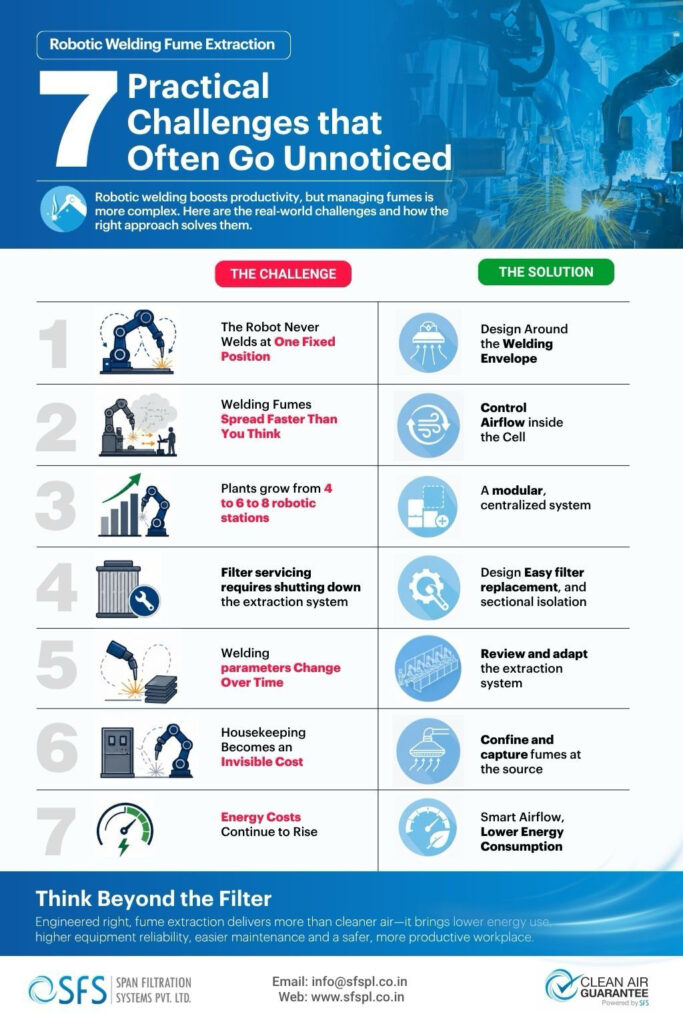
1. The Robot Never Welds at One Fixed Position
A robotic arm constantly changes its position, angle, and reach. The welding plume moves with it.
If the extraction system is designed around only one welding location, fumes escape whenever the robot moves outside the effective capture zone.
The Solution
Instead of designing around the robot, design around the entire welding envelope. Capture points, extraction hoods, or enclosure airflow must remain effective throughout the robot’s full range of motion.
2. Welding Fumes Spread Faster Than You Think
High-speed robotic welding creates thermal currents that carry fumes rapidly across the welding cell/zone.
These fumes often migrate to adjacent workstations before they are extracted, exposing nearby operators to extremely polluted air in the breathing zone.
The Solution
Confine the welding fumes and capture them effectively. Proper airflow direction and effective extraction ensure contaminants move toward the extraction point instead of across the shop floor.
3. Production Expands Faster Than Filtration
A plant may start with four robotic welding stations.
Six months later, it becomes six.
Then eight.
Unfortunately, many extraction systems are designed only for today’s production.
The Solution
A modular centralised system allows new robotic cells to be integrated without replacing the complete filtration infrastructure.
Future expansion should be considered during the first phase of design.
4. Maintenance Stops Production
In many robotic welding installations, filter servicing requires shutting down the extraction system.
This often means stopping multiple welding cells simultaneously.
The Solution
Design the system with maintenance accessibility in mind. Easy filter replacement, sectional isolation, and, if required, the placement of filtration units outside the manufacturing area reduce production interruptions while making maintenance safer and faster.
5. Welding Parameters Change Over Time
As production evolves, manufacturers introduce new materials, thicker sections, higher deposition rates, or different filler wires.
These changes directly influence fume generation.
A system designed for yesterday’s process may gradually become undersized.
The Solution
Review the extraction system whenever major welding process changes occur. Filtration should evolve with production not remain static.
6. Housekeeping Becomes an Invisible Cost
Even when visible smoke is controlled, fine particles often settle on robots, fixtures, sensors, electrical panels, and safety equipment.
Over time, this leads to increased cleaning effort, sensor contamination, and unnecessary maintenance.
The Solution
Effective fume extraction should extract smoke, fumes and airborne particles before they settle on equipment, improving air quality in the breathing zone along with equipment reliability and reduced housekeeping.
7. Energy Costs Continue to Rise
Robotic welding cells often run across multiple shifts.
Running extraction fans at full capacity even when only a few welding stations are active results in significant energy waste.
The Solution
Integrate Variable Frequency Drives (VFDs) and intelligent airflow control. Fan speed can automatically adjust based on the number of active welding cells, reducing energy consumption while maintaining effective extraction.
Think Beyond the Filter
Successful robotic welding fume extraction isn’t simply about installing a larger collector.
It requires understanding robot movement, airflow behaviour, production changes, maintenance strategy, and long-term operating costs.
When these factors are engineered together, manufacturers gain more than cleaner air. They benefit from lower energy consumption, improved equipment reliability, easier maintenance, and a safer, more productive welding environment.
How SFS Helps
At Span Filtration Systems (SFS), we engineer robotic welding fume extraction systems around the realities of production. From stand-alone units to centralised extraction units with smart filtration and intelligent VFD control, every solution is designed to deliver cleaner air, lower lifecycle costs, and the flexibility to grow alongside your manufacturing operations.