

The soldering iron touches the joint.
The solder melts. A thin curl of smoke rises. Within seconds, it disappears.
That disappearing act is precisely why soldering fumes are often underestimated.
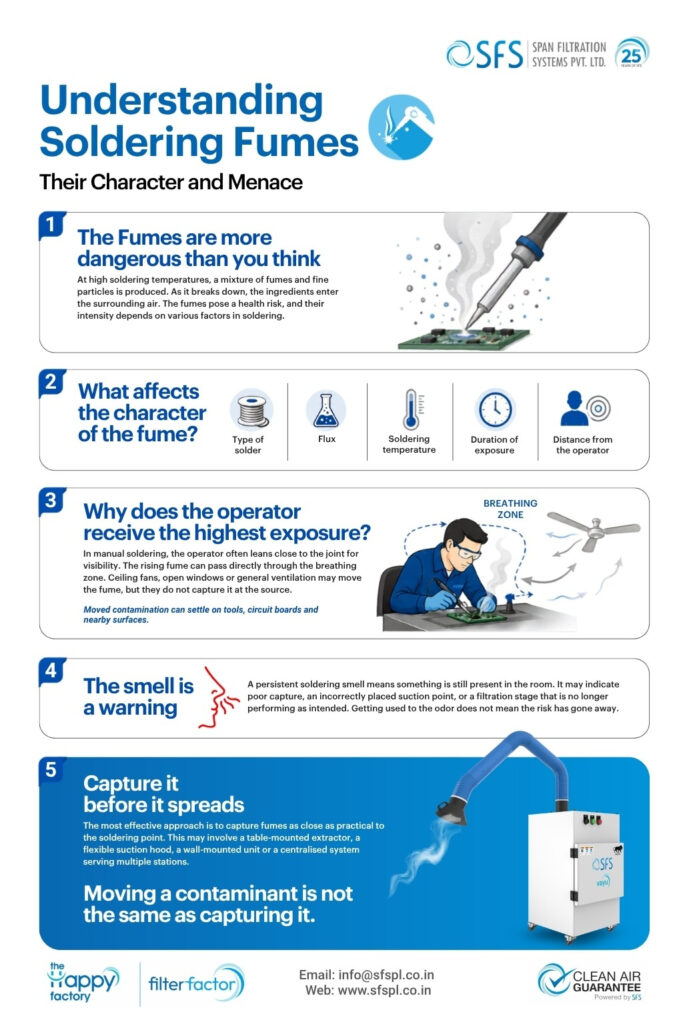
The smoke is not just smoke
Soldering uses heat to join metals. As the solder and flux are heated, they release a mixture of smoke and fine particles.
A significant part of the visible fume comes from the flux. Flux cleans the surfaces and helps the solder form a reliable joint. But when heated, its ingredients break down and enter the surrounding air.
The exact character of the fume depends on several factors:
- Type of solder
- Composition of flux
- Soldering temperature
- Duration of exposure
- Distance from the operator
Lead-free solder does not automatically mean fume-free or risk-free. Resin-based and other fluxes can still release substances that irritate the eyes, nose, throat and respiratory system. The referenced soldering safety presentation also highlights respiratory irritation and occupational asthma as concerns associated with repeated exposure.
Why does the operator receive the highest exposure?
Look closely at a manual soldering station.
The operator normally leans over the workpiece for a clear view of the joint. Unfortunately, the rising fume often travels directly through the operator’s breathing zone.
A ceiling fan may move it away from the face. General ventilation may dilute it. An open window may make the smell less noticeable.
But moving a contaminant is not the same as capturing it.
The fume can travel across the workstation and settle on tools, circuit boards and surrounding surfaces. Some of it may eventually return with recirculating room air.
The smell is a warning
A persistent soldering smell tells us that something is still present in the room.
It may mean that fumes are not being captured effectively, the suction point is too far away or the filtration stage is no longer performing as intended.
Operators may gradually become accustomed to the odour. That does not mean the problem has disappeared. It may simply mean that the workplace has accepted it as normal.
Capture it before it spreads
The most effective approach is to capture fumes as close as practical to the soldering point.
This could involve a table-mounted extractor, a flexible suction hood, a wall-mounted unit or a centralised system connected to several stations. The right arrangement depends on the process, fume quantity, workstation design and operator movement.
Soldering fumes may appear light and momentary. Their effects are far-reaching and dangerous.
SFS offers smart and advanced mist and fume extraction units for soldering fume extraction. Get in touch with us for details. Write to cleanair@sfspl.co.in