
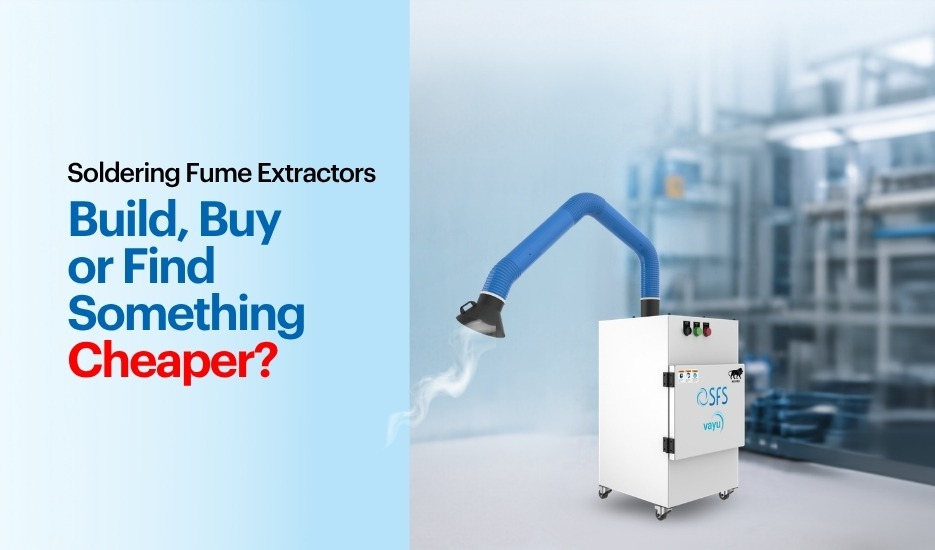
The requirement sounds simple.
“There is some smoke above the soldering station. Put a fan there and pull it away.”
Then the quotations arrive.
One extractor costs a few thousand rupees. Another costs several times more. A homemade arrangement appears even cheaper.
Naturally, the discussion begins.
Purchase wants the lowest price. Production wants uninterrupted work. Safety wants dependable extraction. Maintenance wants something it can support.
Everyone is correct. But they may be evaluating very different things.
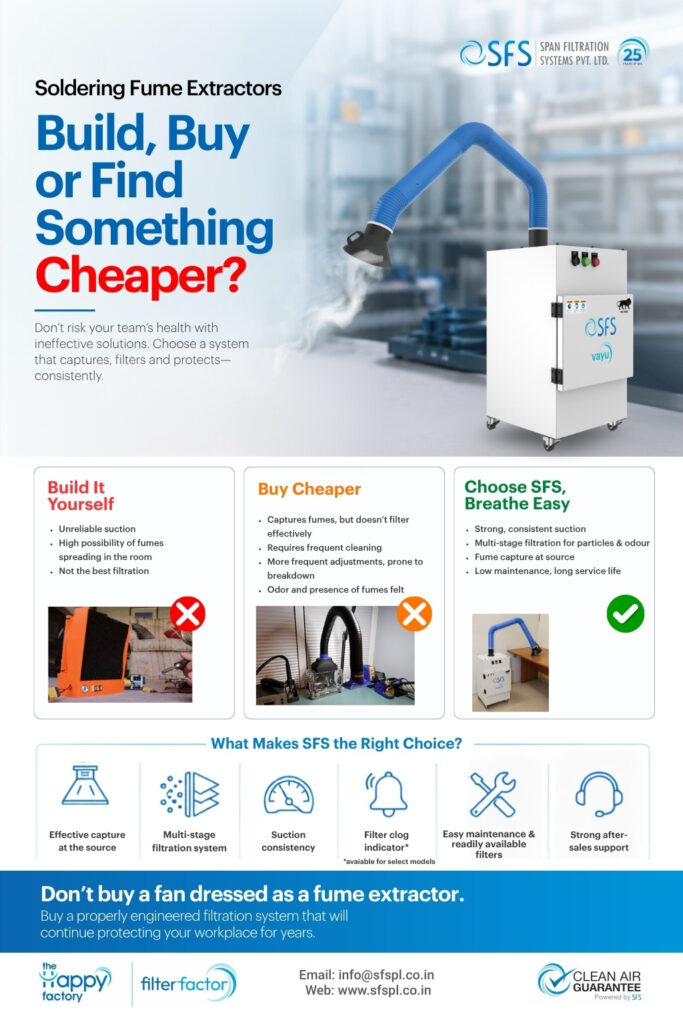
The lowest quotation looks attractive
A small fan in a plastic enclosure can move visible smoke away from the operator’s face. For a few minutes, it may even appear to have solved the problem.
But where does that fume go?
If the unit only pushes it sideways, the contaminant remains in the room. If its suction is weak, fumes escape before reaching the hood. If the enclosure leaks, filtered and unfiltered air may mix. If the filter cannot address both particles and odour, the characteristic smell continues.
What looks like extraction may only be redistribution.
The filter nobody discusses
Filter replacement is often missing from the initial buying conversation.
How many filtration stages does the unit have? What does each stage capture? How will the user know when a filter is clogged? Are replacement filters readily available? What will they cost? Who will remind the maintenance team to change them?
Without clear answers, even a reasonable extractor can slowly become ineffective.
The fan continues to run. The operating light continues to glow. Everyone assumes the system is working.
Meanwhile, suction falls and the staff continues to breathe the fumes.
Fume extraction must be engineered
An effective system is not defined by the fan alone.
It depends on the relationship between the hood, extraction distance, airflow, pressure, ducting, filtration stages and the nature of the fumes. The arm must remain where the operator positions it. The hood must capture the fume without obstructing the work. The enclosure must prevent leakage. The filters must be accessible and replacement must be planned.
That engineering becomes even more important on robotic soldering cells, multiple workbenches and centralised systems.
Price versus lifetime cost
A cheaply built unit may save a few thousand rupees during purchase. But weak suction, frequent breakdowns, unavailable filters, persistent odour and repeated replacement can make it expensive over its lifetime.
The real comparison should therefore include:
- Capture performance
- Filter configuration
- Suction consistency
- Construction quality
- Replacement-filter availability
- Maintenance indication
- After-sales support
- Expected service life
Buying economical equipment is sensible. Buying equipment that merely looks economical is not.
Be particularly careful of products that advertise impressive airflow but provide little information about filtration, filter replacement or capture performance at the actual soldering point.
Do not buy a fan dressed as a fume extractor. Buy a properly engineered filtration system that will continue protecting the workplace for years.