
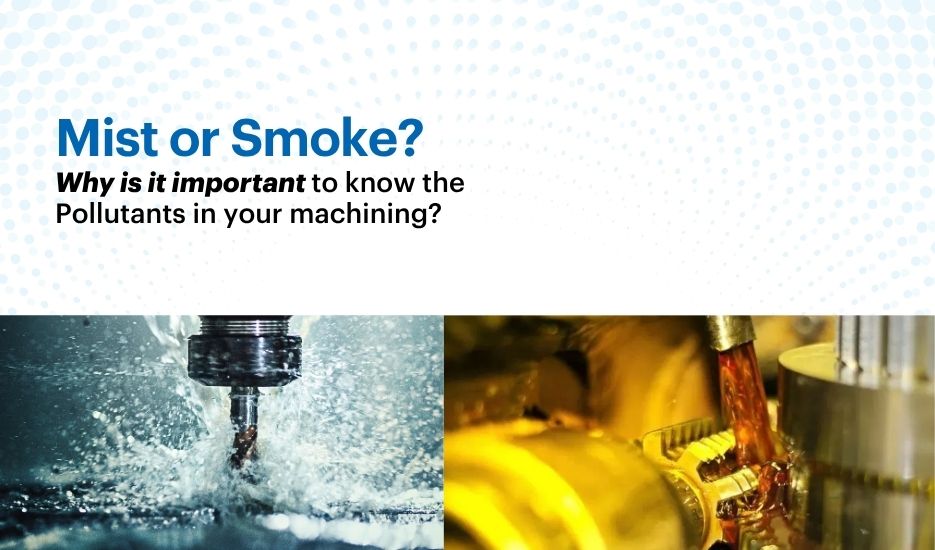
Two machining centres may look similar. Yet the airborne pollutant inside them can be very different.
The difference depends not only on whether the process uses water-miscible coolant or neat oil. Coolant pressure, cutting temperature, tool speed and machining intensity also influence whether the process generates mist, smoke or both.
Understanding the complete process is therefore essential before selecting a filtration system.
Low-Pressure Coolant: Primarily Mist
In low-pressure water-miscible coolant applications, the coolant is broken into airborne droplets by the rotating tool, workpiece and fluid impact.
The pollutant generated is primarily oil mist. Its particles are commonly in the range of approximately 1–10 microns.
Typical applications include:
- CNC turning
- Milling
- Drilling
- grinding
- machining
These particles may remain airborne temporarily before settling on the machine, floor and nearby surfaces. This often creates the familiar wet or sticky residue around machining areas.
A correctly designed mist collector can filter these particles effectively while maintaining stable airflow and enabling proper drainage.
High-Pressure Coolant: Mist and Smoke
The picture changes when water-miscible coolant is delivered at high pressure.
The greater pressure and energy at the cutting zone break the coolant into much finer particles. When combined with high tool speeds and elevated cutting temperatures, the process can produce both visible mist and a fine smoke
This means a high-pressure coolant application should not automatically be treated as a conventional mist application.
The filtration system may need to manage:
- Fine airborne mist
- Smoke
- Higher overall mist and smoke load
Removing the visible mist alone may not be enough. The finer fraction can remain suspended and escape through enclosure gaps even after the machine appears clear.
Neat-Oil Machining: Mist and Smoke
Neat oil behaves differently from water-miscible coolant.
It can generate mist and smoke through mechanical action, even when supplied at relatively low pressure. When exposed to friction, high cutting temperatures and rapid tool movement, it can also produce much finer oil-smoke particles.
Therefore, both low- and high-pressure neat-oil machining can generate a combination of mist and smoke. The proportion of each depends on the process parameters.
Typical applications include:
- Gear grinding
- Hobbing
- Gear cutting
- Honing
- Superfinishing
- Other neat-oil machining
Both the mist and smoke contribute to oily deposits. The fine smoke particles may remain airborne longer, travel further and create a lingering haze across the shopfloor.
They can eventually settle on lighting, machine controls, electrical panels, air-conditioning systems and finished components.
The Process Changes the Pollutant
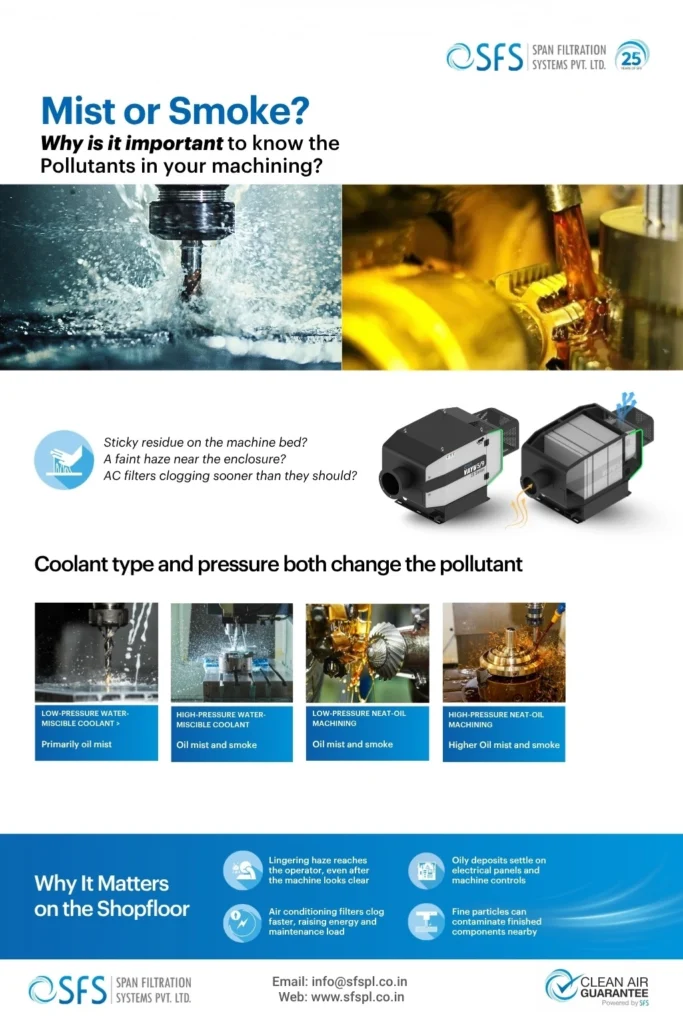
| Machining condition | Likely pollutant |
| Low-pressure water-miscible coolant | Primarily oil mist |
| High-pressure water-miscible coolant | Oil mist and smoke |
| Low-pressure neat-oil machining | Oil mist and smoke |
| High-pressure neat-oil machining | Higher Oil mist and smoke load |
This is a practical starting point, not a substitute for studying the actual machining process. Temperature, tool speed, enclosure design, coolant flow, material removal rate and machining operation can change the pollutant characteristics considerably.
Why One Collector May Not Suit Every Process
A conventional mist collector is primarily designed to separate liquid droplets. It may work well for low-pressure water-miscible coolant applications but may not adequately capture and filter the fine smoke generated by high-pressure coolant or neat-oil machining.
Mist filtration generally requires:
- Effective droplet separation
- Stable extraction airflow
- Proper oil drainage
- Suitable filter capacity
Mist-and-smoke filtration requires more. The system must manage the while capturing the finer airborne fraction.
This generally calls for a carefully engineered, multi-stage filtration arrangement. The initial stages separate larger droplets and manage the oil load. The finer stages capture the smaller mist and smoke particles before clean air is returned to the shopfloor.
Clear Air Can Be Misleading
A machine enclosure may appear clear once the visible haze disappears. But visual clarity does not confirm that the finest particles have been captured.
Fine aerosols may still pass through an unsuitable collector, escape from the enclosure and remain suspended in the surrounding air.
The real question is not simply:
“Can the collector remove the visible mist?”
It is:
“Can it capture the complete range of pollutants generated by this process?”
The Practical Takeaway
Do not select a filtration system based only on the coolant name.
Study:
- Coolant composition
- Coolant pressure
- Cutting temperature
- Tool and spindle speed
- Machining operation
- Pollutant particle range
- Mist and smoke load
Low-pressure water-miscible coolant typically produces mist. High-pressure coolant can produce both mist and smoke-like aerosols. Neat-oil machining can generate mist and smoke at either low or high pressure.
Understand the process first. Identify the pollutant next. Then engineer the filtration system.