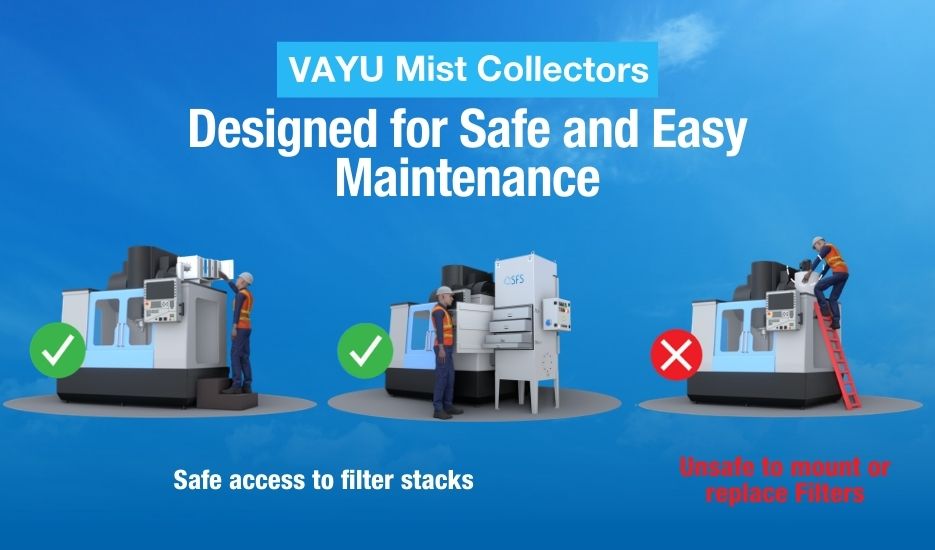
VAYU Mist Collectors Designed for Safe and Easy Maintenance

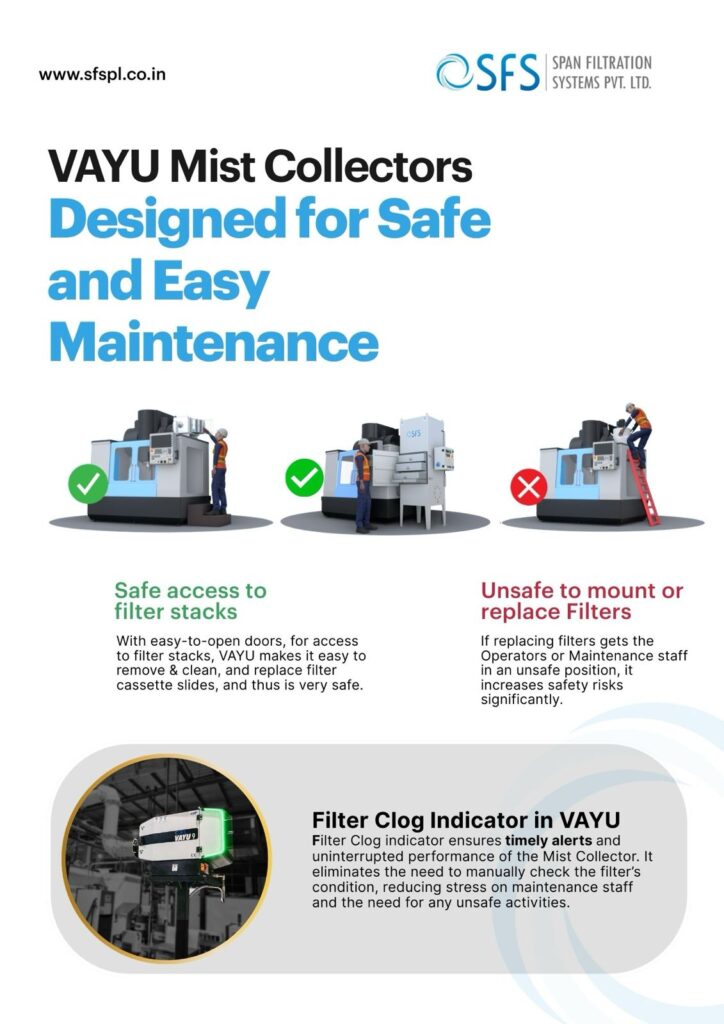
In industrial environments, safety is the top priority. The shopfloor is filled with potential hazards, and maintenance tasks should never add to the risk. Maintenance heads across industries have repeatedly raised concerns about the dangers of the need to work with unsafe practices or getting into unsafe positions to replace the filters frequently. These risks can lead to serious accidents, from injuries to “man-down” incidents that disrupt production and endanger lives.

A Design Focused on Safety and Accessibility

Unlike most other filters in the market, where workers often end up putting themselves in unsafe positions to replace filters, Vayu 25 Series takes a different approach. Its front-opening design allows for easy, safe access to filter stacks, eliminating potential unsafe practices. Maintenance becomes a hassle-free task, reducing the risk of accidents and enhancing operational efficiency.

The Vayu Mist Collector Series is built with the user in mind, designed to minimize downtime and maximize safety. The rectangular filter design may differ from traditional cylindrical models, but its advantages are clear. The accessible filter compartment makes replacements simpler, quicker, and far safer, providing peace of mind for your maintenance staff.

The Vayu 21 Series and Vayu 25 Series Mist Collector, including Vayu 3, Vayu 5, Vayu 9 (Machine or Stand Mounted) and Vayu 9s, Vayu 15 (Floor Mounted, Standalone or Centralised Filters), SFS design prioritises your workforce’s safety and ease of maintenance.

When it comes to safety, Vayu is committed to protecting your team and ensuring that every operation is carried out with confidence.

Your Partner in Safety

With Vayu 25 Series, you’re not just investing in a mist collector; you’re investing in a solution designed with your team’s safety in mind. Protect your workforce, streamline your maintenance process, and minimize downtime with a product that prioritizes safety without compromising on performance or efficiency.

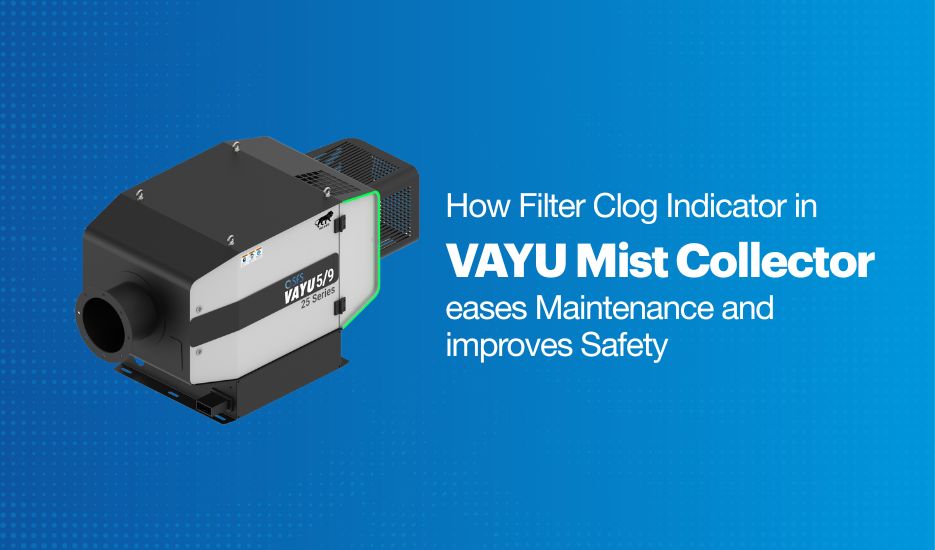
How Filter Clog Indicator in VAYU Mist Collector Eases Maintenance and Improves Safety

Filter Clog Indicator in VAYU Mist Collector: Safer Operations

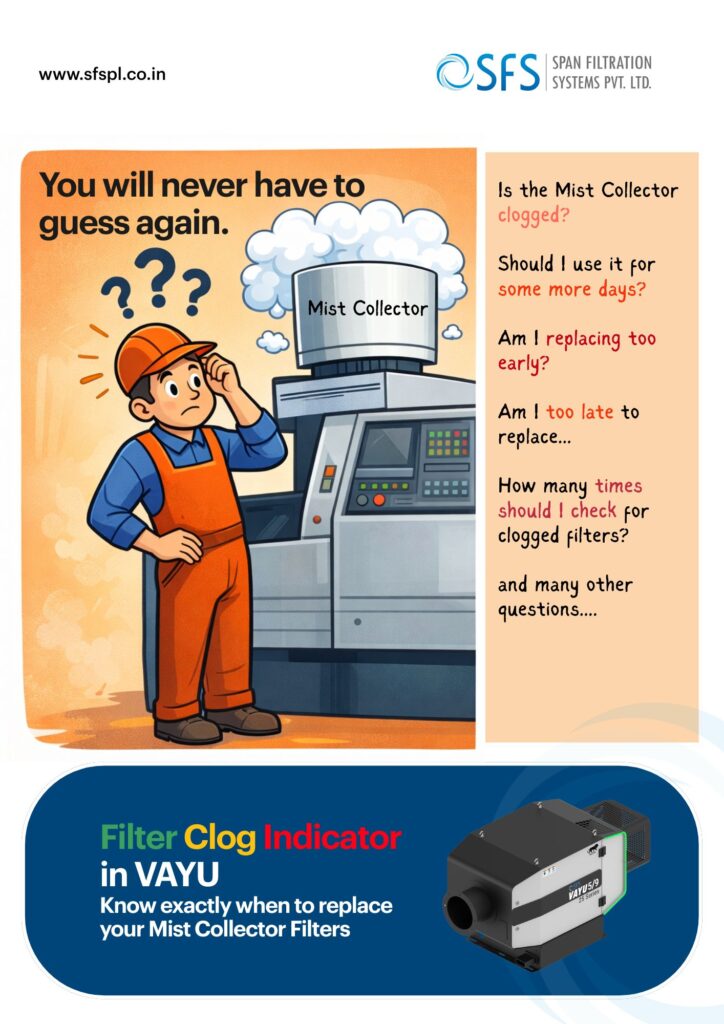
As a Maintenance Head or Plant Manager, you’re well aware of the critical role that filtration systems play in maintaining operational efficiency and safety. But you’re also no stranger to the challenges of filter management. From minimizing downtime to optimizing performance, filter maintenance has always been a balancing act that could be too early, and you waste resources; too late, and you risk system inefficiency or failure.

That’s where Vayu’s Filter Clog Indicator comes in. This simple, yet powerful feature is designed to simplify your decision-making, drastically improving the way you manage filter maintenance. Let’s take a practical look at how this tool can make a significant impact on your plant operations.

Filter Clog Indicator in VAYU Mist Collector

The Problem: Uncertainty and Inefficiency in Filter Maintenance

In many plants, maintenance teams face the constant uncertainty of when to change filters. Without precise data, they often rely on guesswork or scheduled intervals. But this approach has its drawbacks:

Unnecessary Downtime: Replacing filters too early results in unnecessary downtime and wasted resources, impacting production schedules.

Reduced Efficiency: Clogged filters left too long can cause system inefficiencies, leading to higher energy consumption, degraded performance, and costly repairs.

Safety Risks: Poor filtration can lead to overheating or system failure, which jeopardizes safety, not only for the equipment but also for the personnel working with it.

How Vayu’s Filter Clog Indicator Makes a Difference

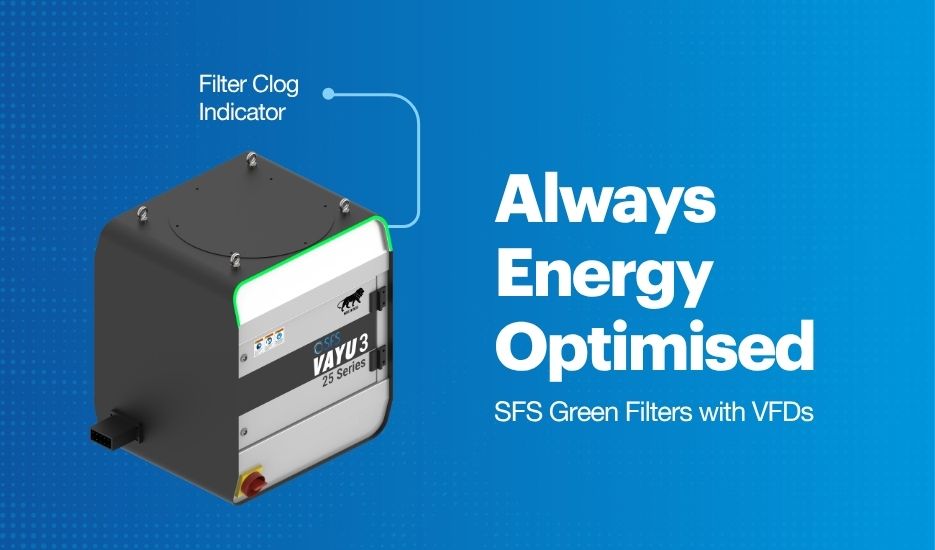
With the Filter Clog Indicator integrated into the VAYU 25 Series and Vayu 21 Series, you now have real-time visibility into the filter condition, providing a clear indication of when maintenance is truly needed. Here’s how it makes an impact on your operations:

The lights on the indicator remove the uncertainty around filter maintenance. You no longer have to rely on scheduled maintenance or vague performance signals. You can act precisely when needed, ensuring that filters are replaced only when they’re truly clogged.
By knowing exactly when to replace a filter, your team can plan maintenance during non-peak hours or scheduled downtimes. This reduces production interruptions and keeps your plant running smoothly.
Keeping filters in service for the optimal amount of time improves overall system performance, reducing unnecessary energy consumption. Filters are replaced at the right time, ensuring maximum efficiency and preventing costly breakdowns.

Clogged filters can cause system overheating or failure, leading to potential safety hazards. With the Filter Clog Indicator, you reduce the risk of unsafe operating conditions, helping to protect both your equipment and your personnel.

Vayu’s Design Philosophy: Practical, Smart, and Safe

At Vayu, every feature is designed with practicality in mind. The Filter Clog Indicator is just one example of how we’ve embedded smart, intuitive technology into our products to make life easier for plant and maintenance heads.

With VAYU’s filter clog indicator, you can make more informed decisions that lead to cost savings, operational efficiency, and a safer plant.

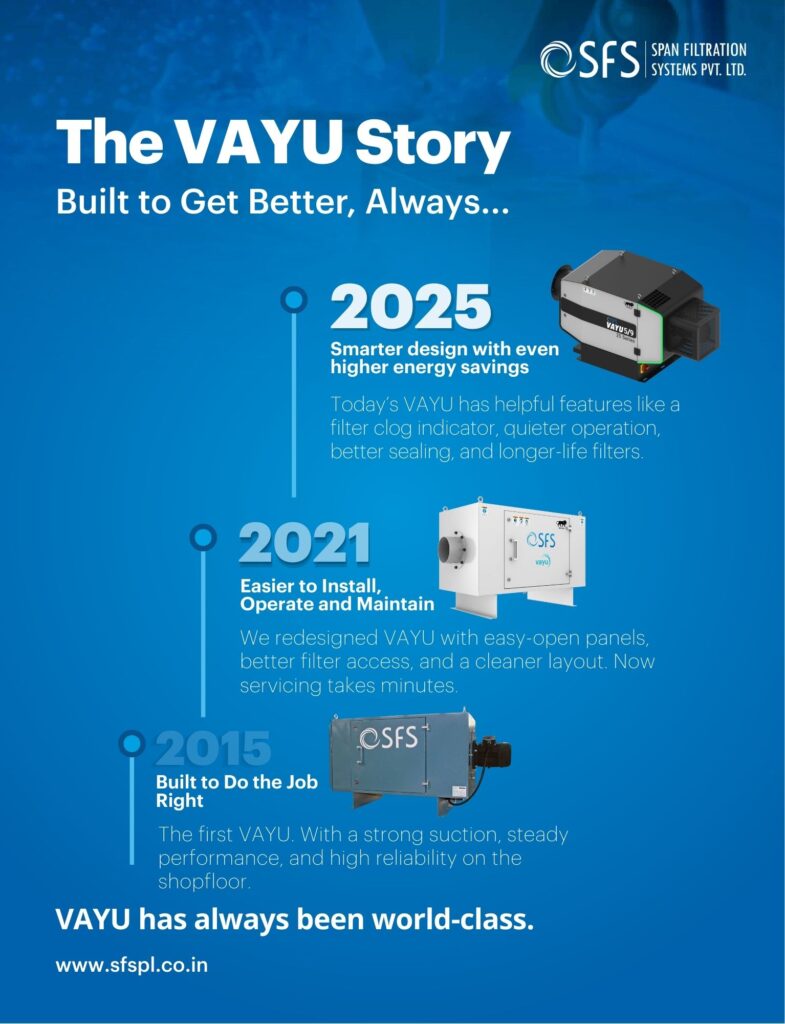
The VAYU Story: Built to Get Better, Always

VAYU Mist Collector has evolved the same way your factory has advanced.
From strong, reliable mist removal to lower power use, easier maintenance, and smarter features like the filter clog indicator, VAYU has always been built to meet your goals.

The first VAYU. With a strong suction, steady performance, and high reliability on the shopfloor.

Next, we focused on what matters every day. Your power bill. VAYU became more energy-efficient, giving the same clean air but using much less electricity. Many factories saw savings almost immediately.

We redesigned VAYU with easy-open panels, better filter access, and a cleaner layout. Now servicing takes minutes.

VAYU 2025: Smarter design with even higher energy savings

Today’s VAYU has helpful features like a filter clog indicator, quieter operation, better sealing, and longer-life filters. These small improvements make a big difference in daily running.

VAYU has always been world-class.

And has been getting easier, smarter, and more efficient. We are constantly listening to your needs and improving our filters to meet them.

In case you are looking for an effective mist collector, we have 2 options – the proven VAYU 21 Series and the new VAYU 25 Series.

Finding Real Energy Savings on the Shopfloor: A Practical Look at What Really Works

Every manufacturing leader today is under pressure to make their operations more energy efficient. Energy audits, new technologies, government pushes – the conversation is everywhere. But here’s the challenge: when everyone is talking about savings, how do you know which ones are real?

Why does Energy Efficiency feel like a puzzle?

There are savings on paper. There are savings that come with a long list of ifs and buts. Some ideas look great in presentations but don’t move the needle in your actual bills. Then there are tiny efficiency tweaks, good for reports, but hardly noticeable on the bottom line.
And finally, there are the big-ticket initiatives — new equipment, major process overhauls, or automation projects that sound great but demand heavy upfront investment and long payback periods. So, how do you navigate this maze?

The not-so-obvious solution is industrial air filters

One area that’s often overlooked but surprisingly powerful – is industrial air filtration. Every mist collector, fume extractor, or dust collector on your shopfloor quietly consumes energy day after day. In a typical factory, the energy bills for each mist collector range from ₹60,000 to ₹1,00,000 per year. Multiply that by 50 or 100 machines, and you’re looking at a serious cost center.

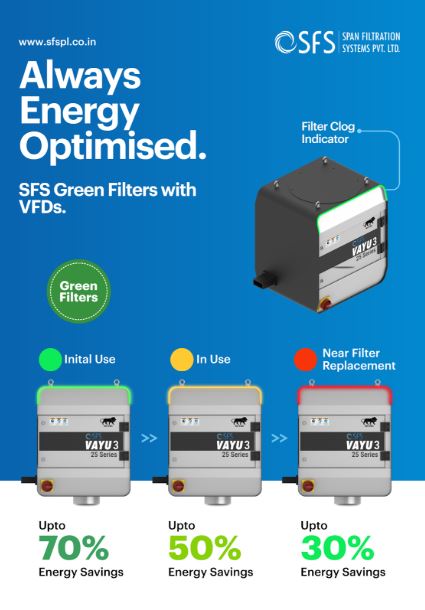
This is where smart engineering can create real savings. Take, for example, the Vayu Mist Collector with Variable Frequency Drives (VFDs) designed to adjust fan speed based on actual airflow needs. That means you’re not running the motor at full load all the time. In practice, this leads to around 50% reduction in energy costs – savings that aren’t just promised on a brochure but are visible right on the shopfloor’s electricity meter.

Think of it like upgrading from a car that always runs at full throttle to one that intelligently adjusts speed depending on traffic. You still reach your destination, just using half the fuel.

For decision makers, energy efficiency isn’t just about finding opportunities for savings. It’s about trusting where they come from in real, measurable, repeatable improvements that compound over time. VAYU filters offer a great avenue. If you need references for the installations and savings achieved, we will be happy to help.

Always Energy Optimised – SFS Green Filters with VFDs

Air filtration is essential in any modern manufacturing setup—but it often comes at a hidden cost: excessive energy consumption. Traditional filtration systems run at constant speed, regardless of how much extraction and filtration is actually required at any given moment. This not only drives up electricity bills but also increases wear and tear on equipment.

At Span Filtration Systems (SFS), we’ve re-engineered the approach. Our Green Filters, equipped with Variable Frequency Drives (VFDs) and smart airflow control, adapt in real time to process demands—delivering up to 30% savings in energy costs.

Let’s break down how it works.

The Problem: Fans That Don’t Know When to Stop

In many factories, air filtration fans are sized for peak load—and then left to run at full speed all day. Whether the process is running light, idle, or under maintenance, the fan keeps pulling maximum power. For a typical 15 kW fan motor, this leads to:

● High energy bills
● Unnecessary extraction
● Premature motor and filter wear
● No control over performance or cost

The Solution: Smart Fan Speed with VFDs

Variable Frequency Drives (VFDs) are the heart of our Green Filter energy-saving strategy. Here’s what they do:

● Continuously monitor air demand (dust, mist, smoke load)
● Based on pressure changes in the line adjusts fan motor speed to match real-time needs
● Ramp down during idle periods, and ramp up only when required
● Maintain optimum airflow while consuming only as much power as needed

The Science Behind the Savings

Here’s the key principle:

Fan power consumption is proportional to the cube of its speed.

So, if you reduce the fan speed by:

● 10%, you save ~27% energy
● 20%, you save ~50% energy
● 30%, you save nearly 66% energy

That means even small speed reductions yield massive power savings. For a 15 kW fan motor, a smart VFD can easily help you avoid hundreds of units of electricity every month.

Real-World Impact

At SFS, we’ve seen customers report:

Up to 30% lower electricity bills on filtration systems
Less strain on fan motors and filter media (longer lifespan)
Lower CO₂ emissions, supporting decarbonisation targets

This isn’t theory, it’s engineered into every Green Filter we offer.

In an era where energy costs are rising and carbon emissions are under scrutiny, intelligent filtration systems offer more than clean air, they offer competitive advantage.
SFS Green Filters don’t just purify, they optimize. And it starts with a fan that knows when to slow down.

4 Proven Strategies to Optimise Your Industrial Filtration Costs

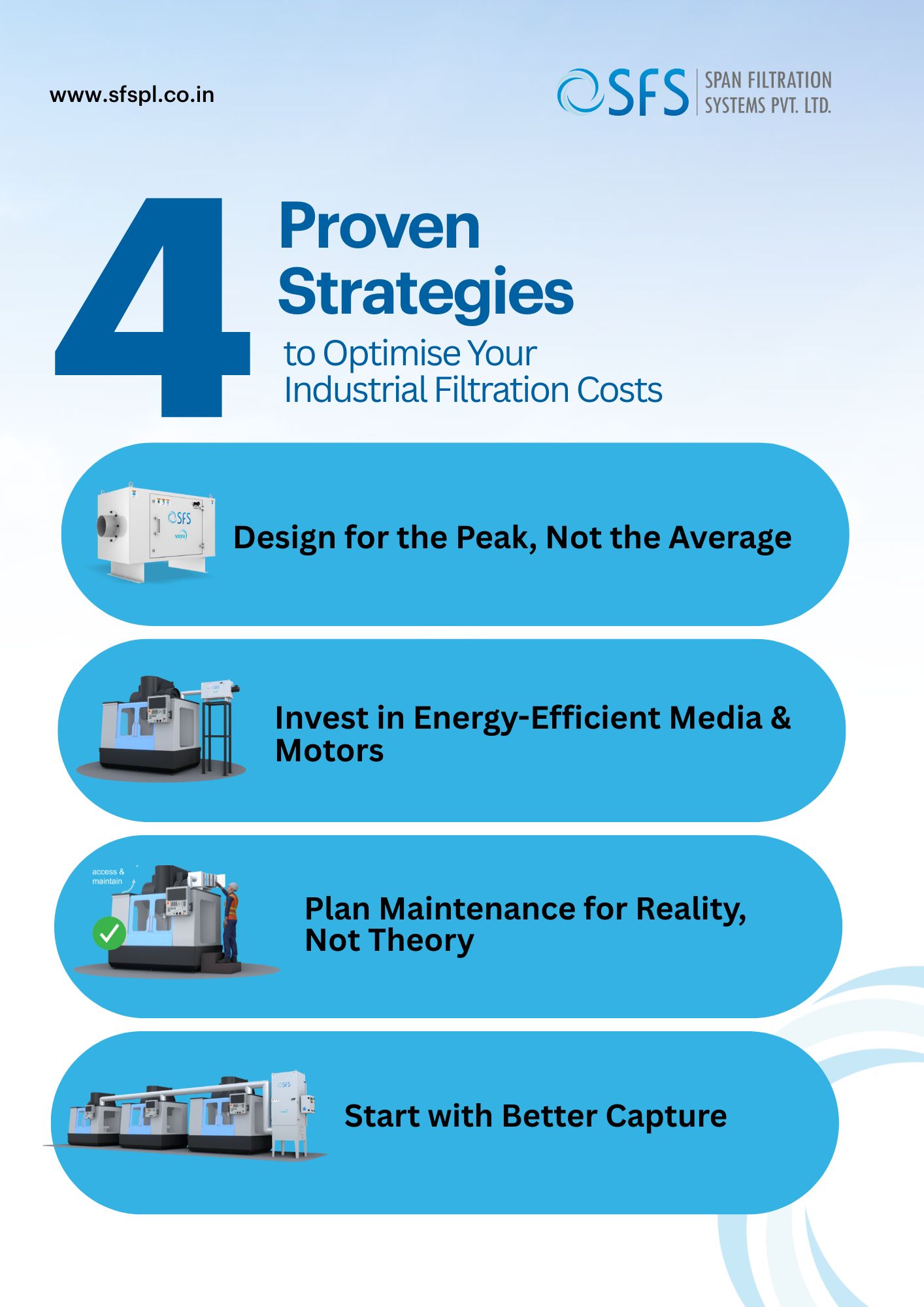
Whether you’re filtering mist, smoke, dust or fumes, filtration expenses can quietly add to your OPEX if not managed smartly. Here are four practical strategies to keep your air clean and your costs lean:

1. Design for the Peak, Not the Average

Why: Undersized filters could choke under load spikes, causing frequent clogging and downtime combined with /inefficient extraction leading to escape and spread of the pollutant

How: Factor in peak particulate generation during worst-case shifts—not just average throughput—to avoid overload and premature media replacement.

Result: Longer filter life,efficient extraction, fewer breakdowns, and no emergency retrofits.

2. Invest in Energy-Efficient Media & Motors

Why: Filters run 24/7, and motor horsepower costs add up.

How: Use optimised suction capacity with VFD-drives that adjust airflow based on load.

Result: minimum30% lower energy bills across the system lifecycle.

3. Plan Maintenance for Reality, Not Theory

Why: Most filters fail not because of age, but neglect.

How: Install clog indicators, use easily accessible designs, and train staff on quick-change procedures.

Result: Increased uptime, Lower labour costs, fewer unscheduled shutdowns, and efficient filter performance.

4. Start with Better Capture

Why: Poor capture = more contamination in the air = oversized filters and higher loading.

How: well designed filters with optimised suction capacities to ensure effective capture, extraction and filtration.

Result: Optimised suction capacities lead to efficient energy and filtration requirement , meaning smaller systems with , longer media life, and lower operating costs.

Bottom Line:
Optimising filtration isn’t about compromises, but engineering smarter. These strategies help you reduce energy, spares, and labour costs without compromising air quality or compliance. Start early in your planning phase and the savings will follow for years.

Industrial Filtration: The Blind Spots on the Road to a World-Class Factory

When manufacturers set out to build a world-class factory, they invest heavily in machines, automation, layouts, and aesthetics. But one critical pillar often gets sidelined until problems surface — industrial air filtration. From energy waste and equipment failures to employee dissatisfaction and lost credibility, the hidden cost of ignoring clean air is massive. In this blog, we explore the common blind spots, planning fallacies, and long-term risks decision-makers overlook — and why filtration deserves a seat at the master planning table if you’re truly aiming for world-class.

Typical Industrial Air Filtration Blindspots

Typical Overlooked Area

Why It’s Ignored

Risk When It’s “Too Late”

World-Class Payoff

True Lifetime Cost(energy + spares + downtime)

Purchase price dominates Excel models; electricity tariff escalation & consumables skipped

OPEX spirals, CFO blocks future upgrades

Lowest total cost of ownership, predictable operational budgets

Capacity Creep

“Today’s production volume” used as design basis

Extra lines added ⇒ filters undersized, contaminants soar

Modular, future-proof layout supports growth without re-engineering

Dynamic Load Profiles

Mist/dust peaks vs. averages not mapped

Sensors overload; filter media saturates early

Performance that works as per design and VFD-driven systems auto-match load and also save 25-30 % energy

Cross-Contamination Paths

HVAC and material flow rarely co-planned with filtration

Poor work environment, relatively higher maintenance 

Airflow zoning ensures clean environment

Maintenance Reality

PM schedules written, not lived; skills underestimated

Bypass, duct leaks, unplanned shutdowns

Quick-change cartridges & visual clog indicators keep uptime high

Data & Transparency

No KPIs for air quality; meters only on utilities

Can’t prove ROI or meet ESG audits

Checking actual air quality from time to time builds credibility with customers & investors

Human Experience

Focus on machines, not people

Fatigue, absenteeism, high attrition

Clean air boosts morale, retention, and productivity

Brand & Reputation

Visitor routes staged; back-end areas ignored

Client audits expose gaps

“Factory visit” becomes a marketing asset, not a risk

Regulatory Horizon

Assume current norms persist

Tightening limits force costly retrofits & penalties

Compliance-by-design safeguards export licenses & global contracts

Decarbonisation Alignment

Filtration seen as “extra load,” not an efficiency lever

ESG targets missed, green-finance premiums lost

High-efficiency media + smart fans cut kWh and CO₂ per part

Clean air isn’t a luxury—it’s a foundation.

As factories scale up, embrace automation, and chase global quality benchmarks, overlooking air filtration can quietly erode everything from machine health to brand trust. The smartest manufacturers treat air quality as a core design parameter, not an afterthought. At Span Filtration Systems (SFS), we’ve helped hundreds of factories transform with our proven range of energy-efficient, low-maintenance filters, built for modern shopfloor realities and global aspirations. If you’re serious about creating a world-class factory, it’s time to give your air the attention it deserves.

Achieving the Lowest Total Cost of Ownership in Filtration: What We Need to Understand First

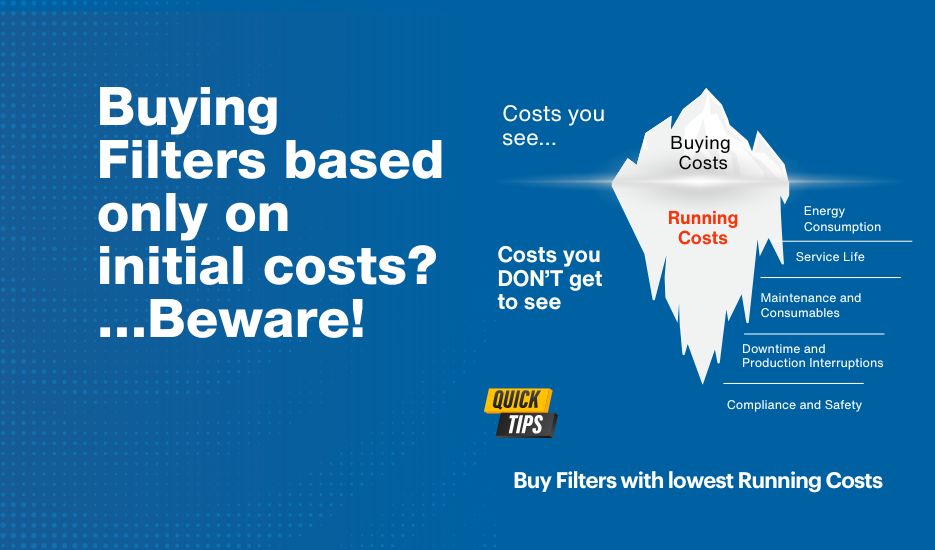
When it comes to filtration in industrial applications, especially in environments like CNC machining, the Total Cost of Ownership (TCO) goes far beyond the sticker price. TCO includes the entire lifecycle of the system: purchase, operation, maintenance, and downtime. Making informed decisions requires understanding the full picture.

1. Initial Purchase Cost vs. Long-Term Savings

A lower-priced filtration system may seem attractive at first, but it often comes with trade-offs like reduced efficiency, shorter lifespan, and more frequent maintenance. Over time, these factors can drive up the total cost far beyond the initial savings. On the other hand, a slightly higher initial investment in a high-efficiency, durable filtration unit can reduce operating costs and extend the service life.

At SFS, filtration systems are designed to balance cost and performance, helping customers maximize long-term value rather than short-term savings.

2. Energy Consumption and Efficiency

Filtration systems are often energy-intensive, especially in operations running multiple shifts. Older or less efficient systems can result in significantly higher electricity bills over time. Choosing energy-efficient systems, such as those with low-power motors or optimized airflow designs, contributes to meaningful reductions in operational expenditure.

Vayu Mist Collectors from SFS are built with energy efficiency in mind, offering high filtration performance with  optimised  energy usage.

3. Maintenance and Consumables

Frequent filter replacements, clogged systems, or difficult-to-source spare parts can lead to both planned and unplanned maintenance, increasing costs and complexity. The cost and availability of spare parts, especially imported ones, can be a major factor in long-term ownership costs.

SFS addresses this by offering  made in India , high-quality components and spares that are reliable, affordable, and easy to source, minimizing disruption and optimising cost.

4. Downtime and Production Interruptions

Unplanned downtimes caused by clogged or failing filters can disrupt production schedules and lead to significant financial losses. Predictive maintenance tools and system designs that alert users before issues arise can help schedule servicing during non-peak hours, reducing the impact on operations.

SFS integrates clog indicators and diagnostic tools into its systems to enable smarter, proactive maintenance and reduce unexpected downtime.

5. Environmental Compliance and Safety

Many industries are now subject to stricter environmental and worker safety regulations. Failure to comply not only risks penalties but may require expensive retrofits or replacements. Filtration systems must meet these standards while also being adaptable to changing norms.

SFS systems are designed with evolving compliance in mind, helping companies stay ahead of regulations and maintain a safe, environmentally responsible workplace.

6. Durability and Service Life

Systems that frequently break down or require early replacement significantly increase ownership and running costs. Materials, design, and build quality all contribute to how long a filtration system will last under real-world industrial conditions.

SFS systems are engineered for durability, ensuring longer life cycles with minimal maintenance needs, an essential factor in lowering TCO.

Reducing the total cost of ownership in filtration is a multifaceted challenge. It demands a deeper look at energy use, maintenance requirements, uptime, environmental impact, and system durability. By making informed choices based on these parameters, manufacturers can build cleaner, more efficient, and more cost-effective operations.

SFS supports this journey by offering thoughtfully designed filtration solutions that optimize performance while lowering lifecycle costs.

How do you want your employees to be?

Mist Collector Costs
Step back for a moment and ask: What do you want your workers to carry with them after every day of work and years of service? Pride? Gratitude? Or health issues from years of breathing unhealthy air? In most manufacturing environments, long-term exposure to oil mist and smoke, fine dust, laser fumes, soldering fumes and welding fumes is far too common. These pollutants may be invisible, but their impact is not.

The Hidden Cost of a Busy Shopfloor

Operators and technicians spend the best hours of their lives on the shopfloor, surrounded by machines that generate heat, smoke, mist, and micropollutants. Over time, this takes a toll on their health, leading to:
  • Respiratory issues
  • Fatigue and reduced focus
  • Potential long-term health complications
  • Reduced workforce morale and productivity

Introducing: The Happy Factory 

The Happy Factory is our answer to this silent crisis. It’s an initiative to make Indian factories not just more productive, but more healthy, clean, and inspiring places to work in. At SFS, we use industrial air filtration solutions configured for specific applications like mist collection, smoke capture, dust extraction, and fume extraction to make your factory environment better.

What We Deliver (Beyond Clean Air)

Healthier, Happier Workforce Clean air boosts morale, reduces sick days, and fosters long-term well-being. Factory Uptime, Always On Clean air = clean machines = lower downtime, and reduced maintenance. Client-Worthy Premises Feel proud to walk in customers without intimation. Impress them with a clean facility. Energy Efficiency with Purpose Right-sized, energy-efficient filters lead to reduced operating costs and higher sustainability. Air Quality Compliance, Simplified Meet local and global air standards with ease, whether you’re a domestic player or an MNC replicating global benchmarks in India.

Why This Matters More Than Ever

In an time where retaining skilled talent is tougher than ever, your work environment becomes your biggest brand ambassador. If you want your workers to be healthy, fulfilled, and proud of where they work, you must create that place today.

So, What’s Your Vision?

A world-class factory isn’t just made of machines. It’s built on the well-being of the people who run them. Let’s build your Happy Factory, together. Talk to SFS. Let’s make clean air your competitive advantage.

Laser Fume Extractor: 10 Alerts Before You Buy

An effective and efficient fume extractor is a game changer.  A poor fume extractor can mean adverse air quality, damage to your equipment, and puts your health at risk. But with so many options out there, how do you know which one’s worth your money? This checklist cuts through the noise Before you buy, check off these 10 must-haves to make sure you’re getting the best deal for your workspace.

  1. Filtration That Actually Works – which filters Does it have ? HEPA + activated carbon filters? Can it trap 99.97% of particles at 0.3 microns? If not, air quality might end up being suboptimal. Odour – Can it handle and eliminate the odour?
  2. Effective Suction, No Compromise Allowed – Weak suction = dangerous fumes left out in the air.
  3. Fits Your Laser Setup – Is it compatible with your laser engraver, or marker? mounting options, and airflow needs.
  4. Easy Filter Swaps – How often do you need to replace filters? Are replacements a pain? If it takes an unreasonable time to change a filter, look for better options.
  5. Not a Noise Monster – Can you actually work with it running ? Is the worker comfortable?
  6. Portable or Fixed? – Do you need a stationary filter or a mobile unit? Stand alone or centralized? If you need flexibility, make sure it’s lightweight and easy to move.
  7. Doesn’t Drain Your Power Bill – Check energy efficiency. Look for auto-shutoff and variable-speed fans so you’re not burning cash.
  8. Compliant with Air quality norms – Does it meet the required standards? Get it checked from the manufacturer and validated.
  9. Strong Warranty & Support – Who’s got your back if it requires support? Check the warranty, spare parts availability, and after-sales support. No support? No deal.
  10. Worth Every Penny – Are you paying for real performance or just fancy features? Compare initial cost, running cost, filter replacement price, and long-term maintenance.

Need help choosing? Let’s talk!

Subscribe Now