






Cleaning Cabinet
Remove coolant, chip/particle Residue From Components
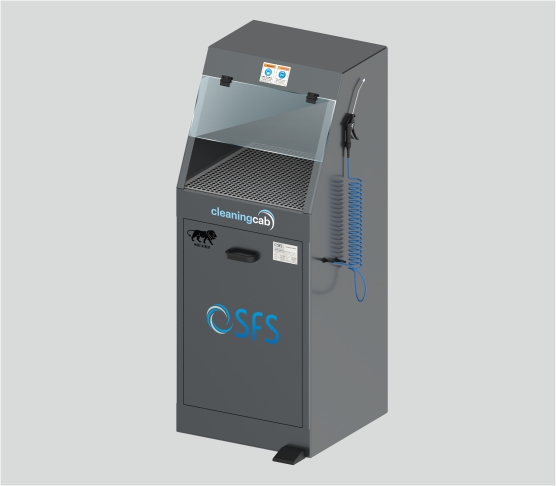
The Cleaning Cabinet cleans the component surface using compressed air and contaminants are collected in a bin below the cleaning platform.
SFS Cleaning Cabinets are well proven and highly popular in surface cleaning of components manufactured by forging, casting, milling, drilling, grinding and many other processes.
Applications
- Cleaning of Machine parts Manufactured by Drilling Grinding Surface Finishing processes and many more...

Key Features of Cleaning Cabinet
- Lightweight, easy to move
- Ergonomically designed
- Robust construction for long life
- Easy to wash, clean and maintain
- Low operational and maintenance costs
Cleaning Cabinet - Video
Complete solution to meet occupational, health and safety requirements

![]() |
Oil smoke is hazardous and long term exposure can pose serious risks to life |

![]() |
The dust and oil settles on the floor and machine surfaces and causes slippery surfaces affecting safety and performance |

![]() |
Potential fire risks are created if oil smoke layers are formed in ventilation pipes, sensitive equipment like control panels etc. |

![]() |
Cutting oil collected during oil smoke extraction can be made available for reuse |

![]() |
Oil smoke levels beyond a certain level in the work environment violate pollution norms |
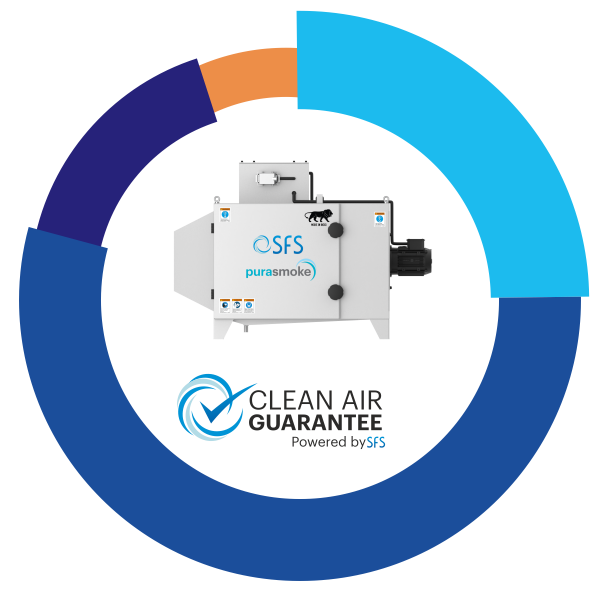
FILTRATION
Effective suction hood design, efficient extraction leads to consistent and efficient filtration
MAINTENANCE
Easy availability and economical spares and consumables
PROCUREMENT INSTALLATION & COMMISSIONING
Designed and manufactured in India under Make in India initiative
OPERATION
Energy efficient systems
Electrostatic precipitator working principle involves ionization of air by applying high voltage to collect the fine soot or dust and oil particles in the smoke and thus filter the air. In an ESP, polluted air passes through two electrodes. These electrodes can be built in the form of bars or plates which are placed inside a pipe. The shape of the electrodes varies according to the type of ESP used.
One of these electrodes is charged with negative voltage which passes on the negative charge to particulates in the smoke passing through the unit. The other electrode situated further along the pipe is charged with positive voltage.
The negatively charged particles are attracted to this electrode and stick to it. The plates used in ESPs can be easily washed and cleaned for reuse.
ESP design
Factors important while designing an ESP
- The size and distributionof particles
- Gas flow rate
- Resistivity of the particles
- Gas temperature
- Chemistry of the particle
Download brochure
Frequently Asked Questions
The Cleaning Cabinet, is a workstation designed to clean component surfaces using compressed air. Its primary function is to remove coolant, chips, and particle residue from parts after manufacturing processes, collecting all contaminants in a bin below the work platform.
The key features include robust construction for long life, an easy-to-clean and maintain design, and low operational and maintenance costs. The main benefits are a cleaner and safer work area, compliance with health and safety requirements by containing dust, and improved efficiency in part cleaning.
It is well-proven for surface cleaning of components manufactured by various processes including milling, drilling, grinding super finishing and many more. It is ideal for machine shops and manufacturing facilities that need to clean parts before assembly, inspection or further processing.
The operator places a component on the cleaning platform inside the cabinet. Using compressed air (supplied from a shop air supply), the contaminants are blown off the part. A downdraft suction system then draws the loosened particles, chips, and residue downward, capturing them in a collection bin. This contained process keeps the workspace clean.